
Cheapest Countries for Hair Transplant in 2026: Cost, Safety and Value Compared
Reviewed by the TransplantHair editorial team
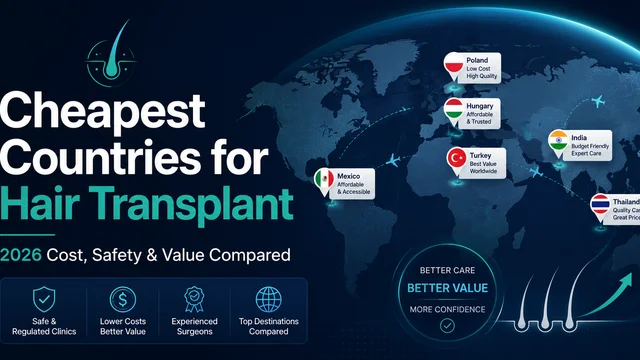
Compare the cheapest countries for hair transplant in 2026 by cost, safety, clinic quality, travel and aftercare. Learn why the cheapest option is not always the best value, and how Turkey, Mexico, India, Poland, Hungary, Thailand, Spain, the UK, Germany and the USA compare.
Cheapest Countries for Hair Transplant in 2026: Cost, Safety and Value Compared
Searching for the cheapest country for a hair transplant is understandable. Hair restoration can be expensive, especially in the United States, the United Kingdom, Germany and other high-cost private healthcare markets. For many patients, travelling abroad can reduce the total price dramatically.
But “cheapest” is not the same as “best”. A low-cost hair transplant can be excellent value when the clinic is transparent, medically responsible and realistic about graft planning. The same low price can become a serious mistake if the clinic overharvests the donor area, hides who performs the surgery or disappears after the patient flies home.
This guide compares the cheapest countries for hair transplant in 2026, including Turkey, Mexico, India, Poland, Hungary, Thailand, Spain, the UK, Germany and the USA. The goal is not to rank countries by price alone. The goal is to help patients understand where the real value is, what risks to watch for and how to compare clinics safely.
Important: TransplantHair currently verifies and lists clinics in Turkey. Other countries in this article are discussed for research and comparison purposes only. They are not ranked, verified or endorsed by TransplantHair.
Quick answer: what is the cheapest country for a hair transplant?
Turkey is often one of the strongest value destinations because it combines relatively low package prices, a large clinic market and a medical tourism system built around international patients. On TransplantHair, listed Turkey package prices currently vary by city, with Istanbul, Antalya, Ankara and Izmir showing live min–max package ranges from clinics listed on the platform. These ranges update as clinics add or change package pricing. (transplanthair.co)
Mexico can be a strong lower-cost option for US patients because it is much closer than Turkey and can be easier to revisit for follow-up. India is often discussed as a budget-conscious option, but patients need to be especially careful about doctor verification and clinic standards. Poland and Hungary can make sense for European patients who want a lower-cost option inside or near the EU. Thailand is usually more of a mid-range medical tourism option than the absolute cheapest choice.
The cheapest country depends on where the patient lives. For a US patient, Mexico may be cheaper once travel is included. For a German or UK patient, Turkey or Poland may be more practical. For a patient already in India, staying local may be cheaper than travelling abroad. The right comparison is not just surgery price. It is surgery price plus flights, hotel, aftercare, time off work, complication risk and the quality of the medical plan.
Why hair transplant prices vary so much by country
Hair transplant pricing is shaped by local labour costs, clinic rent, surgeon fees, patient volume, regulation, marketing costs, currency differences and whether the clinic sells surgery as a medical service or as a travel package. That is why the same patient might receive a very high quote in the United States, a mid-range quote in Spain or Poland, and a lower all-inclusive package quote in Turkey.
In the United States, consumer cost data from CareCredit places the average cost of a hair transplant in a broad range of $4,637 to $12,513, depending on factors such as procedure type, surgeon and case complexity. (carecredit.com) In the UK, the NHS says a private hair transplant can cost anywhere from £1,000 to £30,000, depending on the extent of hair loss, procedure type and clinic quality. (nhs.uk) These wide ranges explain why many patients begin comparing lower-cost destinations abroad.
Turkey is different because many clinics use package pricing. A package may include the procedure, local anaesthesia, post-op medications, airport transfers and 2–3 hotel nights. TransplantHair’s cost calculator notes that many standard all-inclusive FUE and DHI packages in Turkey fall roughly between €2,000 and €5,500, while premium clinics or higher graft counts may exceed that range. (transplanthair.co)
The cheapest option is not always the best value
A cheap hair transplant is only good value if the clinic protects the donor area. Hair transplantation is not like buying a cheaper flight or hotel room. If the donor area is damaged, the patient may not be able to fully repair it later.
The International Society of Hair Restoration Surgery warns that poor FUE planning can create problems such as overharvesting or taking grafts from outside the safest donor area. (ISHRS) This matters more than price. A clinic promising “maximum grafts” or “unlimited grafts” without careful donor assessment can create long-term damage, even if the package looks affordable.
A good clinic should sometimes say no. If the donor area is weak, if the patient is too young, if hair loss is unstable or if the patient expects unrealistic density, surgery may not be the right first step. The cheapest clinic is rarely the best choice if it never refuses a case.
Turkey: usually the strongest value destination
Turkey is often the first country people think of when searching for affordable hair transplant surgery abroad. The country has a large international hair transplant market, especially in Istanbul, and many clinics are used to treating patients from the UK, Germany, the Nordics, the Middle East, the United States and other regions.
The main advantage is the package model. A Turkish clinic may organise the consultation, surgery, hotel, airport transfer, translator support, first wash and remote follow-up in a single offer. For international patients, this can make planning much easier than arranging every detail separately.
On TransplantHair, patients can compare Turkish clinic package ranges by city. Istanbul currently has the widest number of listed pricing profiles, while Antalya, Ankara and Izmir also show live package ranges from clinics listed on the platform. (transplanthair.co) Turkey’s official HealthTürkiye platform also provides a way to check certified healthcare providers and facilitators serving international patients, which can be used as one verification step before trusting a clinic abroad. (Sağlık Türkiye)
Turkey’s weakness is the same as its strength: the market is large. There are excellent clinics, average clinics and clinics that rely too heavily on marketing. Patients should compare doctor involvement, donor planning, before-and-after cases, aftercare and the number of patients treated per day before making a decision.
Best for: international patients who want strong value, many clinic options and organised travel support, but are willing to compare clinics carefully.
Mexico: the practical low-cost option for US patients
Mexico is not always the cheapest country in the world, but for American patients it can be one of the most practical lower-cost options. The travel distance is shorter than Turkey, and some patients living in California, Arizona or Texas may find Mexican clinics easier to reach and revisit.
This is especially important for aftercare. A patient in San Diego considering a clinic in Tijuana has a very different follow-up situation than a patient flying from Chicago to Istanbul. Shorter travel does not automatically mean better medical care, but it can reduce some of the practical burden.
Mexico still requires serious due diligence. Patients should check whether the clinic operates in a properly authorised medical setting and whether the doctor is qualified. COFEPRIS, Mexico’s federal health risk protection authority, is the official body responsible for sanitary risk control in areas including health establishments and medical regulation. (Gobierno de México)
Best for: US patients who want lower costs than domestic surgery and prefer shorter travel than Turkey.
India: low-cost potential, but verification matters
India is often discussed as one of the cheaper countries for hair transplantation because of lower operating costs and a large private healthcare market. For patients already living in India, it may be one of the most affordable options. For international patients, however, the picture is more complicated.
India can offer very competitive pricing, but the clinic market is large and uneven. A patient should not choose based only on price, Instagram results or a high graft promise. Doctor verification, clinic hygiene, surgical responsibility and aftercare need to be checked carefully.
For Indian patients or international patients considering India, the most important question is not whether India can be cheap. It can. The real question is whether the clinic can clearly prove who is performing the procedure, what medical registration they hold, how many patients they operate on per day and how complications are handled.
Best for: budget-conscious patients who can verify the doctor and clinic carefully before booking.
Poland: affordable European care with easier regional follow-up
Poland is often a reasonable option for European patients who want lower prices than the UK or Germany but prefer to stay inside Europe. It may be especially practical for patients in Poland, Germany, Czechia, Slovakia, the Baltics or Scandinavia.
The advantage of Poland is not only price. It is geography. For nearby patients, a Polish clinic may be easier to visit for consultation, washing, early review or long-term follow-up than a clinic in Turkey. That matters for patients who feel anxious about remote aftercare.
Poland also has a public healthcare entity register. The Register of Entities Performing Medical Activities, known as RPWDL, is an open electronic register where users can obtain information about entities performing medical activities in Poland. (healthinformationportal.eu) This does not prove a clinic is the best choice, but it gives patients a starting point for checking whether a medical entity is properly registered.
Best for: European patients who want a lower-cost EU option and easier regional follow-up than long-haul medical tourism.
Hungary: mid-low European medical tourism option
Hungary, especially Budapest, is already known for medical tourism in areas such as dental care and private procedures. Hair transplantation is a smaller part of that market compared with Turkey, but it can still be relevant for European patients comparing lower-cost options.
Hungary may not offer the same scale of hair transplant package competition as Turkey, but it can appeal to patients who want an EU-based destination with shorter travel than Turkey, especially from Central and Western Europe. The trade-off is that clinic choice may be narrower, and patients should pay close attention to experience, case photos and aftercare.
For patients comparing Hungary with Turkey, the key question is whether EU-based access and easier travel justify a possibly higher total cost or smaller clinic market. For some patients, that trade-off may be worth it. For others, Turkey’s larger package market may be more attractive.
Best for: European patients who want a smaller EU medical tourism option and do not want to travel as far as Turkey or Asia.
Thailand: not always cheapest, but strong medical tourism infrastructure
Thailand is often associated with medical tourism, especially in Bangkok and Phuket. It has strong hospitality infrastructure and many private clinics used to international patients. However, Thailand is usually not the cheapest option for a hair transplant when compared with Turkey, India or some Eastern European destinations.
Thailand may appeal to patients in Asia-Pacific regions who want a private medical tourism experience with good travel infrastructure. It can also appeal to patients who value service, comfort and a destination that is already used to international healthcare visitors.
The main caution is cost-to-value. If a patient is travelling from Europe or North America purely to reduce hair transplant costs, Thailand may not always beat Turkey or Mexico once flights and hotels are included. If the patient is already in Asia or wants a broader medical tourism trip, Thailand may make more sense.
Best for: Asia-Pacific patients or international patients who value medical tourism infrastructure and are not looking for the absolute lowest price.
Spain, UK, Germany and USA: usually not the cheapest, but sometimes the right choice
Spain, the UK, Germany and the USA are not usually the cheapest places for a hair transplant. Their advantage is different. They may offer easier local consultation, stronger in-person follow-up and a more familiar private healthcare environment for local residents.
Spain can be attractive for European patients who want EU-based care and clinics in cities such as Madrid, Barcelona and Valencia. Patients can also check healthcare centres through Spain’s national healthcare centre registry, REGCESS, which allows users to search authorised health centres, services and establishments. (Regcess)
The UK and Germany are usually higher-cost markets, but local follow-up may be valuable for patients with complex cases, repair surgery needs, anxiety about travel or medical conditions that make overseas surgery less comfortable. The USA is often the most expensive option for American patients, but it can still be the right choice when local accountability and face-to-face follow-up matter more than price.
The important point is that “expensive” does not automatically mean better, just as “cheap” does not automatically mean unsafe. Every country has good and bad clinics. The clinic’s planning matters more than the flag.
Medical tourism risks patients should understand
The CDC defines medical tourism as travelling internationally for medical care and notes that people often travel for lower-cost procedures or care they cannot easily access at home. It also warns that medical tourists may rely on social media, friends or private companies when choosing where to go, and that cosmetic tourism is one of the common categories of medical travel. (Hastalık Kontrol ve Önleme Merkezleri)
The main risk is not travel itself. The risk is travelling without a clear medical plan. The CDC advises medical tourists to discuss complication planning, follow-up care and insurance coverage before travelling. It also notes that complications abroad can create additional costs, and that patients may not have the same legal recourse as they would at home. (Hastalık Kontrol ve Önleme Merkezleri)
Hair transplant patients should take this seriously. Even though hair transplantation is usually outpatient and performed under local anaesthesia, it still involves surgery. Infection, poor growth, scarring, overharvesting, swelling, pain and unsatisfactory cosmetic results can happen. A cheap package should never be accepted without written aftercare instructions and a clear plan for what happens after the patient returns home.
Cheapest vs best value: how to think about the decision
The cheapest country is the one with the lowest advertised price. The best-value country is the one where the patient can receive a safe, realistic and well-supported result at a fair total cost.
Those are not always the same thing.
A patient who lives in the United States may find Mexico cheaper after travel, even if Turkey has a lower surgery package. A patient in Germany may find Turkey or Poland more practical. A patient in India may not need to travel at all. A patient with a complex repair case may be better off paying more for local follow-up.
The real comparison should include the full cost: surgery, flights, hotel, transfers, time off work, medications, possible extra nights, follow-up care and the cost of fixing a bad result. Once those are included, the cheapest-looking option is not always the cheapest real option.
A realistic country-by-country value ranking
If the goal is pure affordability, India, Turkey and Mexico often appear near the low-cost end of the market. If the goal is affordable treatment with strong international patient infrastructure, Turkey usually becomes one of the strongest choices. If the goal is lower-cost care inside Europe, Poland and Hungary become more relevant. If the goal is premium medical tourism in Asia, Thailand may be worth comparing but is usually not the cheapest.
For patients from the UK, Germany, the Netherlands or Scandinavia, Turkey often offers the strongest combination of price, clinic choice and package convenience. For US patients, Mexico and Turkey are usually the two most practical international comparisons. For Central European patients, Poland and Hungary may be easier for follow-up, while Turkey may offer stronger package competition.
The best country is the one where the patient can compare enough clinics, verify medical responsibility and get a realistic plan without being rushed into surgery.
How to compare cheap hair transplant quotes safely
The safest way to compare quotes is to ignore the price for the first five minutes and look at the medical plan. A good quote should explain how many grafts are planned, why that number is realistic, how the donor area will be protected and which technique is being recommended.
It should also explain who performs each part of the surgery. Extraction, channel opening and implantation are not minor details. They affect graft survival, direction, density and naturalness. If the clinic cannot explain who does what, the patient should slow down.
Aftercare should also be clear before payment. The patient should know when to send photos, who reviews them, how quickly the clinic responds, what symptoms require urgent local care and what happens if growth is poor after 12 months.
A cheap clinic that answers these questions clearly may be better than an expensive clinic that avoids them. But a cheap clinic that refuses transparency is not good value.
Red flags in low-cost hair transplant offers
The biggest red flag is an “unlimited grafts” promise without donor assessment. The donor area is not unlimited. A clinic that treats it like an endless resource may create permanent thinning or patchiness.
Another red flag is pressure. If a clinic pushes a same-day discount, says the offer expires immediately or makes the patient feel guilty for asking questions, that is a bad sign. Medical decisions should not feel like flash sales.
Patients should also be cautious when travel logistics are clearer than the medical plan. If the clinic explains the hotel, driver and payment process perfectly but cannot explain graft planning, surgical responsibility and aftercare, the patient should not rush.
Final verdict: what is the cheapest country for a hair transplant?
Turkey is often the best overall value choice for international patients because it combines lower package pricing, a large clinic market and medical tourism infrastructure. Mexico can be the most practical low-cost option for many US patients because travel is shorter. India can be very affordable, but verification is especially important. Poland and Hungary can be useful European alternatives for patients who want lower prices while staying closer to home. Thailand is usually better understood as a medical tourism option rather than the cheapest option.
The safest choice is not the cheapest country. It is the clinic that protects your donor area, gives a realistic graft plan, explains the risks and supports you after surgery.
If you are considering Turkey, start by comparing verified clinics, real package price ranges and clinic details on TransplantHair before contacting providers.
Editorial note
This article was prepared for educational and comparison purposes. Sources include TransplantHair platform data, official health tourism resources, public health regulators, medical tourism safety guidance and public healthcare information. TransplantHair currently verifies and lists clinics in Turkey only.
Medical disclaimer
This article is for educational purposes only and does not replace medical advice. Hair transplantation is a surgical procedure. Always consult a qualified medical professional before making a treatment decision.
FAQ Items
What is the cheapest country for a hair transplant?
Turkey, India and Mexico are often among the lower-cost countries for hair transplant surgery. Turkey is frequently one of the strongest overall value options because it combines package pricing, many clinic choices and medical tourism infrastructure.
Is Turkey the cheapest country for hair transplant?
Turkey is often one of the cheapest high-volume international destinations, especially for package-based FUE and DHI procedures. However, prices vary by clinic, city, graft count, technique and package details.
Is the cheapest hair transplant safe?
A cheap hair transplant can be safe if the clinic is authorised, transparent and medically responsible. It becomes risky when the clinic promises unrealistic graft numbers, hides doctor involvement or has poor aftercare.
Which country is cheapest for US patients?
Mexico may be the most practical lower-cost option for many US patients because travel is shorter. Turkey may offer stronger package competition, but flights and recovery planning require more time.
Which country is cheapest for European patients?
Turkey is often one of the strongest value options for European patients. Poland and Hungary can also be worth comparing for patients who prefer an EU-based or nearby option.
Why is hair transplant cheaper abroad?
Hair transplant prices abroad can be lower because of lower operating costs, currency differences, high clinic competition and package-based medical tourism models. Lower price does not automatically mean lower quality, but patients must verify clinics carefully.
What should I check before choosing a cheap hair transplant clinic?
Check doctor involvement, clinic authorisation, donor area planning, graft estimate, before-and-after cases, number of patients per day and aftercare. The clinic should explain who performs extraction, channel opening and implantation.
Is it better to choose the cheapest country or the best clinic?
The clinic matters more than the country. A safe, transparent and realistic clinic in a slightly more expensive country can be better value than the cheapest clinic in a lower-cost destination.