
Hair Transplant in Turkey for German Patients: Cost, Travel, Safety and Clinic Selection
Reviewed by the TransplantHair editorial team
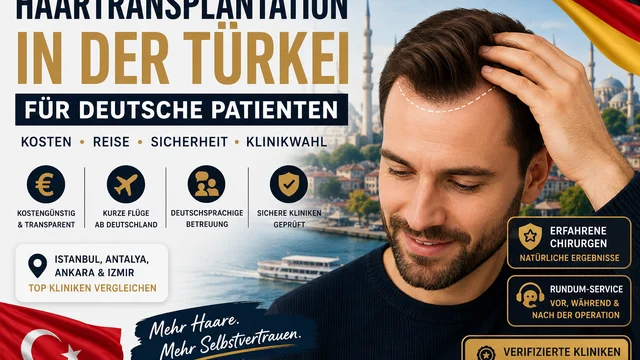
A practical guide for German patients considering a hair transplant in Turkey. Learn about cost, travel, German-speaking clinic support, safety checks, recovery planning and aftercare before choosing FUE or DHI surgery abroad.
Hair Transplant in Turkey for German Patients: Cost, Travel, Safety and Clinic Selection
For many German patients, Turkey appears in hair transplant research for a simple reason: the price difference can be significant. A procedure that may cost several thousand euros in Germany can often be offered as a package in Turkey, sometimes including hotel, airport transfers, translator support, medication kits and the first wash.
But a hair transplant in Turkey should not be chosen only because it is cheaper. The real question is whether the clinic gives a realistic graft plan, protects the donor area, explains who performs each surgical step and provides clear aftercare after the patient returns to Germany.
Turkey can be a strong option for German patients when the clinic is transparent, medically responsible and experienced with international patients. It can also become risky if the decision is based only on a low price, a social media transformation or a promise of “maximum grafts”.
This guide explains what German patients should know before travelling to Turkey for FUE, DHI or Sapphire FUE hair transplant surgery.
Important: TransplantHair currently verifies and lists clinics in Turkey. This article is for educational and comparison purposes only and does not replace medical advice.
Why German patients choose Turkey for hair transplants
Germany has experienced doctors and private clinics, but hair transplant surgery can be expensive. German cost references often place hair transplantation in the range of €3,500–€12,000 without robotic assistance, with robotic-assisted procedures reported higher in some cases. The final price depends on graft number, technique, clinic, surgeon involvement and case complexity. (myBody.de)
Turkey uses a different model. Many clinics offer package-based pricing instead of quoting only per graft. On TransplantHair, patients can compare listed Turkey package ranges by city, including Istanbul, Antalya, Ankara and Izmir. The cost calculator explains that all-inclusive FUE and DHI packages in Turkey often range roughly between €2,000 and €5,500, depending on graft count, hotel tier and clinic reputation. (TransplantHair)
For German patients, this difference can make Turkey look very attractive. Flights are usually shorter than long-haul medical tourism destinations, many clinics have German-speaking coordinators, and Istanbul has a large international hair transplant market. But the package model can also make patients focus too much on convenience. Hotel, transfer and translator support are useful, but they do not replace medical planning.
The price gap is the reason many German patients begin comparing Turkey. The clinic’s medical quality is the reason they should slow down before booking.
Quick comparison for German patients
Cost: Turkey is usually cheaper than Germany because many clinics use package pricing. Germany is usually more expensive, but local consultation and in-person follow-up are easier.
Travel: Turkey is a practical short-to-medium medical trip from Germany, especially with direct flights to Istanbul, Antalya and Izmir. Still, patients need to plan recovery time rather than treating the trip like a normal holiday.
Aftercare: German clinics are easier to revisit in person. Turkish clinics usually provide remote follow-up after the patient returns home, which can work well only if the aftercare process is clear.
Language: German-speaking coordinators can make communication easier in Turkey. However, language support is not the same as doctor involvement or surgical quality.
Clinic choice: Turkey has a large international hair transplant market, especially in Istanbul. This gives patients many options, but quality varies widely.
Best fit: Turkey can make sense for German patients who want package value, are comfortable travelling and are willing to compare clinics carefully before booking.
Main caution: Do not choose based only on price, graft count, German-language ads or Instagram results. Donor planning, surgical responsibility and aftercare matter more than the package.
How much does a hair transplant in Turkey cost for German patients?
For German patients, Turkey’s package pricing is often the biggest attraction. A Turkish clinic may offer surgery, hotel, transfers, translator support, medications and first wash in one package. This can make the process feel simpler than arranging consultation, surgery and recovery separately in Germany.
However, “all-inclusive” does not mean every clinic includes the same things. Some packages include two nights in a standard hotel, while others include longer stays or upgraded accommodation. Some include PRP, while others charge extra. Some clinics are more doctor-led, while others rely more heavily on technician teams. The same price can mean very different things depending on the clinic model.
The fair comparison is not simply “Turkey is cheaper than Germany”. The fair comparison is the full cost of the decision: procedure, flights, hotel, transfers, time off work, medication, aftercare, possible extra nights and the cost of managing a complication after returning to Germany.
A low-cost package can be poor value if the clinic overharvests the donor area or gives an unrealistic graft estimate. A higher-priced package can be good value if the medical team is more transparent, the donor plan is conservative and aftercare is structured.
How long should German patients stay in Turkey?
A Turkey hair transplant trip from Germany is usually easier than travelling from the United States or Canada, but patients should still avoid rushing the process. Even if the surgery can be completed in one day, the early recovery period matters.
A realistic trip often takes around 3–5 days. The first day is usually arrival, transfer and hotel check-in. The second day may involve consultation, blood tests, hairline design and surgery. The next day is often used for rest or the first wash, depending on the clinic’s protocol. Some patients return to Germany shortly after the first wash, while others prefer one extra recovery day before flying.
German ordinary and official passport holders are exempt from visa for travel to Turkey for up to 90 days, according to Turkey’s Ministry of Foreign Affairs. (Dışişleri Bakanlığı) Germany’s Federal Foreign Office also states that German citizens can enter Turkey with documents such as a passport, temporary passport or identity card, although entry and exit rules can change and should be checked before travel. (Auswärtiges Amt)
The travel rules are usually manageable, but patients should not focus only on entry. The return flight, swelling, sleep position, graft protection and ability to rest after surgery are more important than most people expect.
Istanbul, Antalya, Ankara or Izmir: which city should German patients compare?
Most German patients start with Istanbul because it is the largest and most visible hair transplant market in Turkey. Istanbul has the widest clinic selection, the strongest international patient infrastructure and the most package competition. For patients who want to compare many clinics, Istanbul is usually the natural starting point.
Antalya can appeal to patients who want a more relaxed travel setting, but a hair transplant trip should not be treated like a beach holiday. Sun exposure, swimming, alcohol, sweating and heavy activity are usually restricted during early recovery. Ankara and Izmir may offer fewer clinic choices than Istanbul, but they can still be worth comparing if a patient wants a different clinic environment or a less tourism-heavy setting.
The city should not decide the surgery. The clinic should. A responsible clinic in a smaller market can be a better choice than a heavily advertised clinic in Istanbul. German patients should compare doctor involvement, donor management, case photos, pricing transparency and aftercare before choosing a destination.
German-speaking coordinators are useful, but not enough
Many Turkish clinics market to German patients with German-language websites, WhatsApp support and German-speaking coordinators. This can be genuinely helpful. Hair transplant decisions involve medical terms, travel logistics and aftercare instructions, so being able to communicate clearly in German can reduce confusion.
But German-speaking support should not be mistaken for medical quality. A coordinator may explain the package, collect photos and schedule the trip, but the patient still needs to know who the responsible doctor is and who performs each surgical step. Extraction, channel opening and implantation are not minor details. They influence graft survival, direction, density and naturalness.
A clinic that communicates well in German but cannot explain the surgical team clearly is still a risky choice. Language support is a service advantage. It is not a substitute for medical transparency.
What should be included in a Turkey hair transplant package?
A good Turkey package should be clear before the patient pays a deposit. The clinic should explain what is included, what is optional and what could change after the in-person assessment.
For German patients, the usual package items are airport transfers, hotel stay, surgery, local anaesthesia, translator support, post-op medication and first wash. Some clinics include PRP or additional treatments, while others charge separately. Flights are normally arranged by the patient.
The most important part of the package is not the hotel or the driver. It is the medical plan. A serious clinic should explain the expected graft range, the donor area limit, the technique, the hairline design, the surgical team and the aftercare schedule. If a clinic explains travel logistics more clearly than the surgery itself, that is a reason to slow down.
The clinic should also be honest about what happens if the graft estimate changes after seeing the donor area in person. A responsible clinic may reduce the graft number if the donor area is weaker than expected. That may be disappointing, but it can be the safer long-term decision.
Safety checks before booking a clinic in Turkey
Turkey has many clinics experienced with international patients, but the market is large and quality varies. German patients should not assume that every clinic advertising in German meets the same standard.
One useful first step is checking whether the provider is authorised for international health tourism. HealthTürkiye states that healthcare facilities and intermediary organisations offering international medical tourism services must receive an International Health Tourism Authorization Certificate under Turkey’s international health tourism rules. (Sağlık Türkiye) Turkey’s Health Tourism Department also publishes healthcare providers authorised by the Ministry. (Sağlık Turizmi)
This does not guarantee a perfect result, but it helps patients separate official healthcare providers from less transparent operators. Patients should still ask who the responsible doctor is, whether they will meet the doctor before surgery, who performs extraction, who opens channels and who implants grafts.
German patients can also compare the process with what they would expect at home. Germany’s Federal Ministry of Health provides a doctor search service through gesund.bund.de, and the German Medical Association explains that its doctor search is built from regional medical chamber and statutory physician association data. These tools can help patients verify local medical providers when comparing Germany and Turkey. (Gesundheitsportal)
Why donor area planning matters more than maximum grafts
Many patients ask clinics for the highest graft number possible. A better question is: how many grafts can be used safely?
The donor area is limited. If too many follicular units are extracted too aggressively, the back and sides of the scalp can become thin, patchy or visibly damaged. ISHRS patient safety material warns that FUE donor overharvesting can happen when too many follicular units are removed from one area or when clinics try to extract too many grafts too quickly. (Fight the Fight)
This is why “unlimited grafts” marketing can be dangerous. The donor area is not unlimited. A clinic that promises a very high number without careful donor assessment may be prioritising short-term visual impact over long-term safety.
For younger German patients, this is especially important. A low, aggressive hairline may look attractive in the first year, but hair loss can continue. If too many grafts are used too early, there may not be enough donor supply later for the crown or mid-scalp. A conservative hairline can sometimes be the smarter long-term plan.
Recovery timeline after a Turkey hair transplant
The biology of recovery is the same whether the procedure happens in Turkey or Germany. What changes is the distance from the clinic after surgery.
The NHS gives a general recovery outline: bandages can usually be removed after 2–5 days, patients should not touch the grafts early on, new hair usually starts to appear around 4 months, and full results may take 10 to 18 months. (nhs.uk)
This timeline helps patients avoid panic. Redness, scabbing and shedding can be part of the early process. The first week is about graft protection. The first month is about healing. The first few months can feel frustrating because transplanted hairs may shed before regrowing. The final result is a long-term outcome, not an instant transformation.
German patients should plan the return home around the first few days of graft protection. A rushed flight, heavy luggage, sweating, poor sleep or accidental rubbing can make recovery more stressful. The clinic should provide written instructions on washing, sleeping, medication, hats, exercise, sun exposure and when to send progress photos.
Aftercare after returning to Germany
Aftercare is one of the biggest practical differences between having surgery in Turkey and staying in Germany. A German clinic is easier to revisit. A Turkish clinic has to support the patient remotely once they fly home.
The CDC’s medical tourism guidance says follow-up care should be coordinated before travel, and patients should be prepared for continuity of care after returning from medical care abroad. (CDC) That principle is very relevant for hair transplant patients. Even if most recoveries are normal, patients should know what to do if they notice infection signs, unusual pain, heavy swelling, poor healing or unexpected shedding patterns.
A good Turkish clinic should explain exactly how remote aftercare works. Who reviews your photos? Is it a doctor, a medical team or a coordinator? How quickly do they respond? What symptoms require urgent local care in Germany? What happens if growth is poor after 12 months?
Remote aftercare can work, but it should not be vague. Before booking, ask yourself a practical question: if something worries you two weeks after returning to Germany, who exactly will answer you?
Common mistakes German patients make
One common mistake is choosing the clinic with the lowest package price. Turkey is affordable compared with many German options, but there is a difference between good value and cheap surgery. If a clinic cannot explain donor planning, doctor involvement or aftercare, the package is not strong no matter how low the price looks.
Another mistake is assuming German-language support means the clinic is medically stronger. Communication is important, but the medical plan is more important. Patients should ask who performs the procedure, not only whether the coordinator speaks German.
A third mistake is trusting before-and-after photos without context. Good case photos should ideally show graft number, timeline, technique, lighting and a hair loss pattern similar to yours. A 12-month result is more meaningful than an immediate post-op photo. A patient with mild frontal recession is not comparable to someone with advanced crown loss.
The final mistake is treating the trip like a holiday. Turkey is a major travel destination, but the first days after a hair transplant should be planned around healing, not sightseeing.
How TransplantHair helps German patients compare Turkey clinics
TransplantHair is designed to make the research stage less chaotic. Instead of relying only on social media ads, WhatsApp quotes or clinic sales messages, German patients can compare Turkish clinics by city, price range, rating, services and profile details.
The cost calculator helps patients understand package ranges before contacting clinics. The compare tool helps users review clinic options side by side. The head scan flow helps patients organise scalp photos and send more structured consultation requests rather than relying on random selfies.
This matters because cross-border decisions need better information. A German patient choosing a clinic in Turkey is not simply booking a local appointment. They are choosing a medical provider abroad. A structured comparison reduces the chance of choosing based on marketing alone.
Questions to ask before paying a deposit
Before paying a deposit, the clinic should answer direct questions clearly. Ask who the responsible doctor is, whether you will meet the doctor before surgery, who performs extraction, who opens the channels and who implants the grafts. Ask how many patients the team treats per day. Ask whether the graft estimate can change after in-person assessment. Ask what happens if your donor area is weaker than expected.
The package questions matter too. Ask whether hotel, transfers, medications, PRP, first wash and aftercare are included. Ask whether the price is fixed. Ask what support you receive after returning to Germany.
You do not need a clinic that gives the most exciting answer. You need a clinic that gives the most honest one.
Final verdict: is Turkey worth it for German hair transplant patients?
Turkey can be worth considering for German patients who want strong package value, many clinic options and a medical tourism system used to international patients. The price difference can be significant, and the process can be convenient when the clinic is organised and transparent.
But Turkey is not automatically the right choice. If you want local follow-up, have a complex repair case, feel anxious about travelling after surgery or prefer direct German medical continuity, a clinic in Germany may be worth the higher cost.
For German patients considering Turkey, the safest approach is to compare clinics carefully, avoid unrealistic graft promises, verify medical responsibility and make sure aftercare is clear before booking.
The best clinic is not the one with the lowest price. It is the one that protects your donor area, gives a realistic plan and supports you after surgery.
If you are considering Turkey, start by comparing verified clinics, real package price ranges and clinic details on TransplantHair before contacting providers.
Editorial note
This article was prepared for educational and comparison purposes. Sources include TransplantHair platform data, German travel guidance, Turkish health tourism resources, German medical directory resources, CDC medical tourism guidance, NHS recovery information and ISHRS hair restoration safety materials. TransplantHair currently verifies and lists clinics in Turkey only.
Medical disclaimer
This article is for educational purposes only and does not replace medical advice. Hair transplantation is a surgical procedure. Always consult a qualified medical professional before making a treatment decision.
FAQ Items
Is Turkey a good option for German hair transplant patients?
Turkey can be a good option for German patients who want lower package prices and many clinic choices, but only if the clinic is transparent, medically responsible and clear about doctor involvement, donor planning and aftercare.
How much does a hair transplant in Turkey cost for German patients?
Turkey hair transplant prices vary by clinic, city, technique, graft count and package details. Many all-inclusive FUE and DHI packages are often in the €2,000–€5,500 range, but premium clinics or complex cases may cost more.
Do German citizens need a visa for Turkey for a hair transplant?
German ordinary and official passport holders are generally exempt from visa for travel to Turkey for up to 90 days. Patients should still check current official entry requirements before booking.
How long should German patients stay in Turkey for a hair transplant?
Many German patients should plan around 3–5 days, including arrival, consultation, surgery, first wash or post-op check and some recovery time before flying home.
Are German-speaking coordinators enough when choosing a Turkey clinic?
German-speaking coordinators are useful, but they are not enough. Patients should still verify doctor involvement, donor planning, surgical responsibility, aftercare and clinic authorisation.
Is Istanbul the best city in Turkey for German hair transplant patients?
Istanbul has the largest and most visible hair transplant market in Turkey, but it is not automatically the best choice for every patient. The clinic’s medical plan matters more than the city.
What should German patients ask a Turkey hair transplant clinic before booking?
Ask who performs each surgical step, how many patients are treated per day, whether the provider is authorised for international health tourism, what aftercare is included and what happens if the graft estimate changes.
Is Turkey cheaper than Germany for hair transplant surgery?
Turkey is often cheaper than Germany because many clinics offer package pricing that may include surgery, hotel, transfers and post-op support. However, the best decision should be based on medical quality, not price alone.