
Hair Transplant Recovery Timeline: Day-by-Day Healing Process, What to Expect & Mistakes to Avoid (2026 Guide)
Reviewed by the TransplantHair editorial team
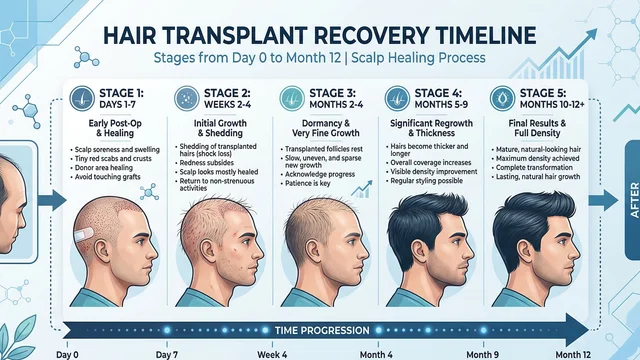
Discover the complete hair transplant recovery timeline with a day-by-day breakdown. Learn what to expect, how long healing takes, and the most common mistakes to avoid for the best results.
One of the biggest concerns people have before getting a hair transplant is not the procedure itself—but the recovery process.
“How long does it take to heal?”
“When will the hair grow?”
“What if something goes wrong?”
In this complete guide, we break down the hair transplant recovery timeline step by step, so you know exactly what to expect after your procedure.
Why Understanding the Recovery Process Is Critical
Many patients focus only on the surgery—but the real success of a hair transplant depends heavily on recovery.
👉 Poor aftercare = bad results
👉 Proper care = natural, dense hair
This is why understanding the timeline is crucial.
Day 0: The Procedure Day
Right after your hair transplant:
Your scalp will be red and sensitive
Tiny incisions will be visible
You may feel tightness or mild discomfort
👉 Important:
Do NOT touch the transplanted area
Sleep with your head elevated
Avoid sweating
Day 1–3: The Most Sensitive Phase
This is the critical healing window.
What happens:
Redness continues
Mild swelling (especially forehead)
Tiny scabs begin forming
What you should do:
Use prescribed spray every 2–3 hours
Avoid direct sunlight
Do NOT wash hair yet (unless instructed)
⚠️ Mistake to avoid:
Touching or scratching grafts can permanently damage them.
Day 4–7: Scabbing Phase
Now your scalp starts healing faster.
What happens:
Scabs fully form
Itching begins
Swelling disappears
What you should do:
Start gentle washing (clinic instructions)
Keep scalp clean
Be patient with itching
👉 This phase is where most people panic—but it’s completely normal.
Day 7–10: Scabs Fall Off
This is a major milestone.
What happens:
Scabs start falling off
Transplanted area looks more natural
👉 IMPORTANT:
Do NOT force scabs off—let them fall naturally.
Week 2–4: Shock Loss Phase
This is where many patients get worried.
What happens:
Transplanted hairs start falling out
Donor area looks normal again
👉 This is called shock loss and it is 100% normal.
❗ The roots are still alive—only the hair shafts fall.
Month 1–3: The “Ugly Duckling” Phase
This is the hardest psychological phase.
What happens:
Very little visible growth
Hair may look uneven
Some redness may remain
👉 Most patients think the transplant failed here—but it hasn’t.
Month 3–6: Growth Begins
Now the exciting part starts.
What happens:
New hair starts growing
Thin and soft hair appears
Density gradually increases
Month 6–9: Visible Transformation
What happens:
Hair becomes thicker
Hairline starts shaping
Noticeable improvement
👉 People around you start noticing results here.
Month 9–12: Final Results
What happens:
Full density achieved
Hair looks natural
You can style it freely
Common Mistakes That Ruin Results
Avoid these at all costs:
❌ Smoking after surgery
❌ Alcohol in first 7 days
❌ Not following washing instructions
❌ Touching grafts
❌ Going to gym too early
❌ Choosing cheap, unverified clinics
Pro Tips for Faster Recovery
Sleep at a 45° angle (first 3 days)
Drink plenty of water
Avoid stress
Use only clinic-approved products
Follow medication strictly
When Should You Be Concerned?
Contact your clinic if you notice:
Severe pain
Excessive bleeding
Infection signs (pus, bad smell)
Extreme swelling
Final Thoughts
Hair transplant is not an overnight transformation—it’s a process that requires patience.
If you follow the correct recovery steps, your results will look:
Natural
Dense
Long-lasting
👉 The difference between a “good” and “perfect” result is how well you handle recovery.