
How Many Grafts Do I Need? Hair Transplant Graft Calculator Guide
Reviewed by the TransplantHair editorial team

One of the first questions most patients ask before a hair transplant is simple: how many grafts do I need?
It is an important question because graft count affects almost every part of your hair transplant plan. It can influence the estimated cost, procedure length, hairline design, density expectations, donor area safety and even which clinic recommendations make sense for your case.
But the answer is not the same for everyone.
Two people with similar hair loss may need different graft numbers because their hair thickness, donor density, hairline goals, age, future hair loss risk and crown involvement may be different. That is why an online hair transplant graft calculator should be used as a rough planning tool — not as a medical diagnosis.
A graft calculator can help you understand your likely range before speaking with clinics. However, the final graft count should always be confirmed by a qualified medical team after reviewing your donor area, hair loss pattern, hair characteristics, density goals and long-term hair loss risk.
This guide explains how graft estimates work, what common graft numbers mean, how the Norwood scale is used, and how to compare clinic recommendations more safely.
What Is a Hair Graft?
A hair graft is a small natural grouping of hair follicles that is removed from the donor area and transplanted into thinning or bald areas.
A graft is not always one hair.
One graft may contain:
Single-hair graft -> 1 hairs
Double-hair graft -> 2 hairs
Triple-hair graft -> 3 hairs
Multi-hair graft -> 4 or more hairs in some cases
This matters because a patient receiving 3,000 grafts may not receive exactly 3,000 hairs. The actual number of hairs depends on how many hairs are naturally present inside each graft.
For example, single-hair grafts are often used in the front hairline because they can create a softer and more natural transition. Grafts with two or three hairs may be used behind the hairline to increase the appearance of density.
Clinics usually plan and discuss hair transplants by grafts rather than individual hairs because grafts are the units extracted and implanted during the procedure. This is why most consultations, quotes and calculators focus on graft count.
Why Graft Count Matters
Graft count is not just a number used for pricing. It affects the overall planning of your hair transplant.
Cost estimate
In some clinics, the price may be influenced by the number of grafts. In Turkey, many clinics offer package pricing, but graft count can still affect the package recommendation, procedure length, technique selection and medical planning.
A person needing 1,800 grafts for hairline correction may receive a very different plan from someone needing 4,500 grafts for advanced frontal and mid-scalp loss.
Density expectations
Grafts determine how much coverage can be created in a target area. However, more grafts do not automatically mean better density. The result depends on the size of the area, hair quality, graft survival, surgical planning and donor capacity.
A smaller area can often be covered more densely than a large bald area using the same number of grafts.
Hairline design
Lowering the hairline usually requires more grafts. A conservative, age-appropriate hairline may need fewer grafts and protect donor reserves for future hair loss.
An aggressive low hairline may look appealing in theory, but it can use too many grafts too early, especially in younger patients with ongoing hair loss.
Donor area protection
Your donor area is limited. Once grafts are removed, they do not grow back in the donor area. This makes donor management one of the most important parts of hair transplant planning.
A safe plan should balance the patient’s goals with the amount of hair that can be responsibly extracted.
Procedure time
Higher graft numbers usually require longer procedure times. Large sessions may also place more pressure on the surgical team, graft handling process and patient comfort.
Natural-looking result
A natural result is not only about the number of grafts. It also depends on graft placement, angle, direction, density distribution and hairline design.
A careful plan with fewer grafts can sometimes look more natural than an overly aggressive plan with a higher graft number.
Avoiding overharvesting
Overharvesting happens when too many grafts are removed from the donor area, leaving visible thinning, patchiness or an unnatural donor appearance.
This is one reason why patients should be careful with clinics that promise very high graft numbers without properly examining the donor area.
Quick Graft Estimate by Hair Loss Area
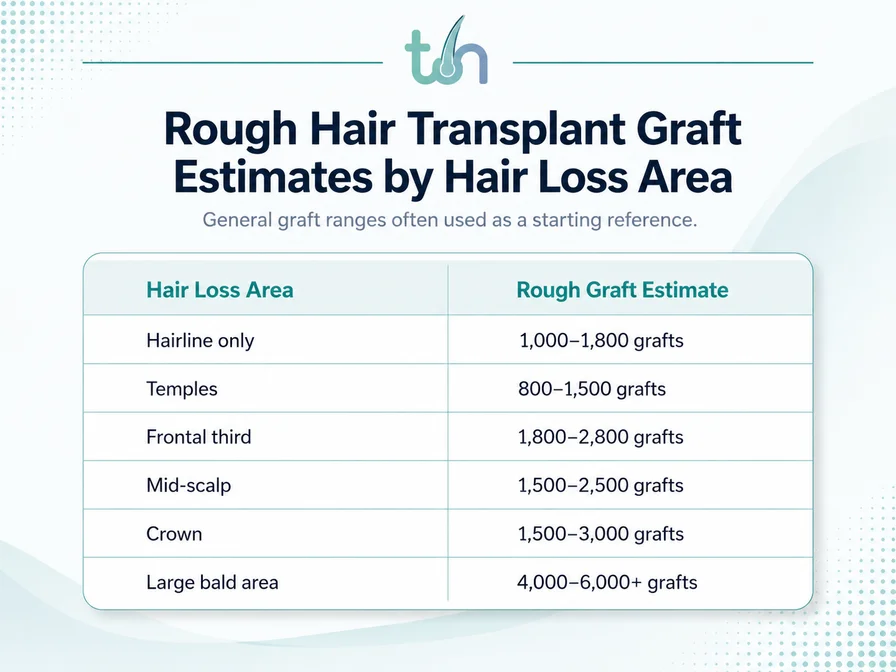
A patient with temple recession may only need a smaller number of grafts. A patient with frontal loss and crown thinning may need a larger plan, possibly staged over more than one session.
The crown is especially important to plan carefully. It often requires many grafts because of the spiral growth pattern, but it may not create the same visual impact as restoring the frontal hairline.
For early planning, you can use the TransplantHair.co hair transplant graft calculator to estimate your likely range before comparing clinics.
Hair Transplant Grafts by Norwood Scale
The Norwood scale is a common classification system used to describe male pattern hair loss. It helps divide hair loss into stages, from mild recession to advanced baldness.
It is useful for planning, but it is not perfect. Two people with the same Norwood stage may still need different graft counts depending on hair thickness, donor density, hairline goals, crown involvement and future hair loss risk.
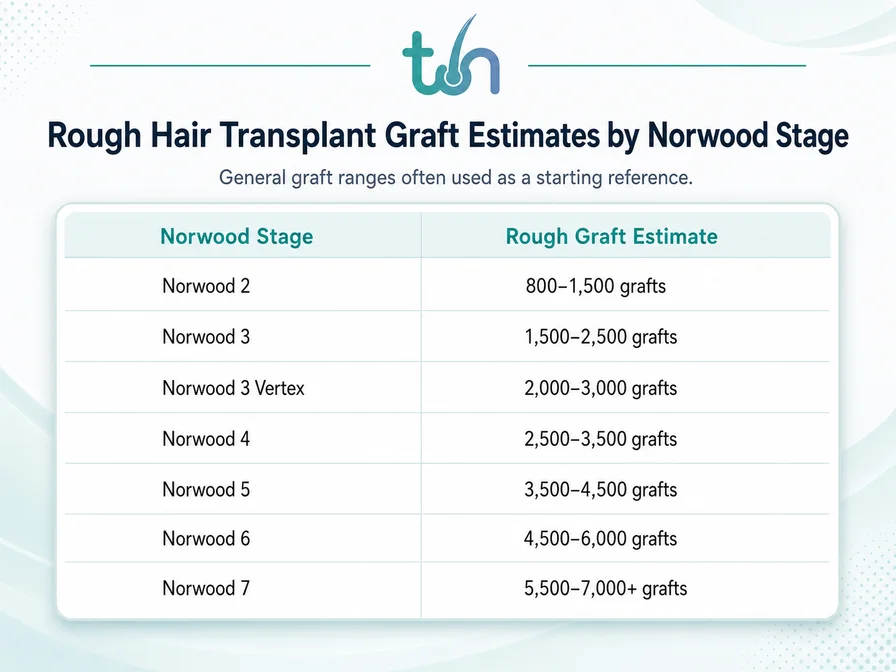
Patients with Norwood 6 or Norwood 7 hair loss usually need especially realistic expectations. Full juvenile density may not be possible because the donor area is limited.
In advanced hair loss, the goal is often to create the best visual improvement with safe donor management. This may mean prioritising the frontal area first, using a conservative hairline, or planning more than one session.
3000 vs 4000 vs 5000 Grafts: What Is the Difference?
Many patients compare common graft numbers such as 3,000, 4,000 and 5,000 grafts. These numbers can be useful, but they should not be treated as fixed packages that apply to everyone.
3000 grafts hair transplant
A 3000 grafts hair transplant is often used for moderate hair loss. It may cover the frontal area, rebuild the hairline and add density behind it.
For some patients, 3,000 grafts may be enough for a strong visible improvement. For others, especially those with crown loss or larger thinning areas, it may only cover part of the problem.
4000 grafts hair transplant
A 4000 grafts hair transplant may be recommended when the frontal area and mid-scalp need wider coverage. It can offer more coverage than 3,000 grafts, but the final result still depends on the size of the area and the patient’s hair characteristics.
If the hair is thick, wavy or has low contrast with the scalp, 4,000 grafts may create a stronger illusion of density. If the hair is very fine and the bald area is large, the same number may appear less dense.
5000 grafts hair transplant
A 5000 grafts hair transplant is usually considered a large session. It may be discussed for advanced hair loss or larger coverage goals.
However, 5,000 grafts is not automatically better. Donor safety becomes critical. The medical team should explain whether the donor area can safely support that number and what areas will be prioritised.
A clinic recommending 5,000 grafts from photos alone should be questioned carefully. In some cases, a staged approach may be safer than trying to do everything in one session.
Factors That Change How Many Grafts You Need
There is no universal graft number for every patient. The right estimate depends on several personal factors.
Hair thickness
Thicker hair usually provides better visual coverage than fine hair. A patient with thick hair may need fewer grafts to create the same visual effect compared with someone with very fine hair.
Hair colour and skin contrast
The contrast between hair colour and skin tone affects how visible thinning appears. Dark hair on light skin often shows thinning more clearly than lighter hair on lighter skin.
Lower contrast can make the scalp less visible and may improve the appearance of density.
Curl or wave
Curly or wavy hair may create more coverage because it occupies more visual space. Straight hair may lie flatter and require more density to create the same effect.
Donor density
Donor density is one of the most important limits. If the donor area is strong, more grafts may be safely available. If donor density is weak, a high graft number may increase the risk of overharvesting.
Age
Younger patients may still have progressing hair loss. In these cases, the medical team may recommend a more conservative plan to protect donor reserves for the future.
Future hair loss risk
If there is a strong risk of future hair loss, grafts should be planned carefully. A very low hairline may look good today but become difficult to maintain if hair loss continues behind the transplanted area.
Hairline position
Lower hairlines need more grafts. A slightly higher, natural-looking hairline may require fewer grafts and create a more age-appropriate result.
Desired density
Some patients want light coverage. Others want high density. Higher density goals usually require more grafts, but donor safety must still come first.
Whether crown coverage is included
Adding the crown can significantly increase the graft estimate. Crown restoration often requires many grafts and may be less visually transformative than frontal restoration.
Previous hair transplant
Previous surgery can change the available donor supply, scar tissue, graft survival planning and density strategy. Patients who had a transplant before should be evaluated more carefully.
Scarring or donor limitations
Scarring, previous overharvesting, scalp conditions or weak donor areas may limit how many grafts can be safely taken.
Why Two Clinics May Recommend Different Graft Counts
It is common for patients to receive different graft estimates from different clinics. One clinic may recommend 2,800 grafts, while another recommends 4,000.
This does not always mean one clinic is wrong. But it does mean you should ask questions.
Different estimates may happen because of:
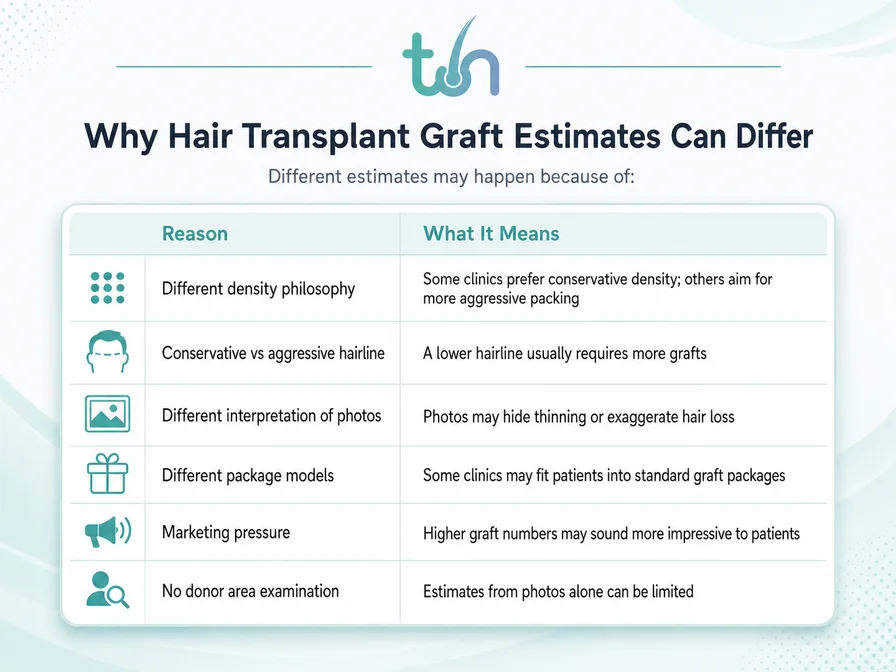
Before accepting a quote, ask the clinic to explain why they recommend that specific graft number.
A responsible clinic should be able to explain which areas are included, what density they are aiming for, how they evaluated your donor area and whether you may need future sessions.
How a Hair Transplant Graft Calculator Works
A hair transplant graft calculator is designed to give users a rough planning estimate before they contact clinics.
A calculator may use information such as:
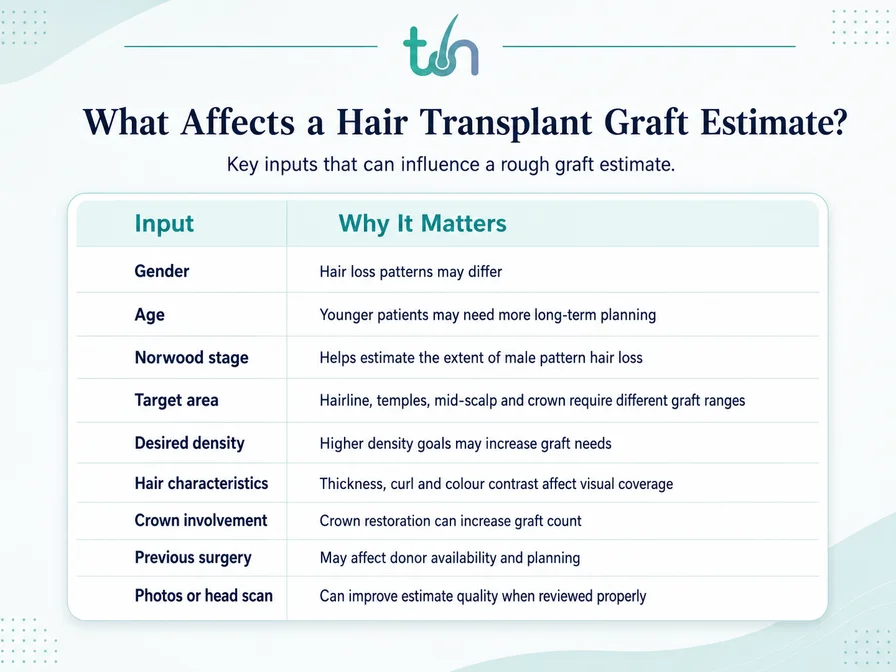
The calculator should not be treated as a final medical decision. It is a planning tool.
Use the TransplantHair.co graft calculator to get a rough estimate of how many grafts you may need. After that, you can compare clinics, calculate possible costs and upload photos through the head scan feature for more detailed feedback.
Graft Count and Cost in Turkey
Turkey is one of the most common destinations for international hair transplant patients. Many clinics in Turkey use package pricing, while some may price by graft, technique or service level.
Even when the price is not calculated strictly per graft, graft count still matters. It can affect:
The recommended package
The procedure length
The technique selection
The size of the medical team needed
The number of sessions
The overall treatment plan
Graft count:
2000 grafts -> Smaller sessions, often hairline or temples
3000 grafts -> Moderate restoration, often frontal area
4000 grafts -> Larger frontal and mid-scalp coverage
5000+ grafts -> Advanced loss, donor planning needed
Exact pricing varies by clinic, technique, doctor involvement, accommodation, transfers, aftercare and medical assessment. Instead of relying on random package claims, use the TransplantHair.co hair transplant cost calculator and live clinic listings to compare options more clearly.
A lower price is not always better. A higher graft number is not always better either. The safest plan is the one that balances coverage, donor protection, medical quality and realistic expectations.
How to Avoid Overharvesting
Overharvesting means too many grafts are taken from the donor area. This can make the back or sides of the scalp look thin, patchy or unnatural.
The donor area is limited, so it should be protected carefully. This is especially important for younger patients, advanced Norwood stages and anyone who may need another session in the future.
Warning signs include:
Warning SignWhy It MattersExtremely high graft numbers promised from photos onlyPhotos may not show true donor capacityNo donor area discussionSafe extraction depends on donor qualityFull-density promisesHair transplant results have biological limitsSame graft count offered to every patientPlanning should be individualNo long-term hair loss planningFuture thinning may require donor reserves
If a clinic promises a very high graft count without discussing donor safety, ask for a clearer explanation before making a decision.
A good plan should not simply chase the maximum number of grafts. It should protect your donor area and consider how your hair may change in the future.
Questions to Ask Before Accepting a Graft Quote
Before accepting a clinic’s graft recommendation, ask practical questions.
Use this checklist:
Why You Should AskWho calculated my graft count? -> To understand whether a doctor or sales consultant made the estimate.
Will a doctor review my donor area? -> Donor safety is essential
Which areas are included? -> Hairline, temples, mid-scalp and crown change the number
What density are you aiming for? -> Density goals affect graft planning
Is the crown included? -> Crown coverage may require many grafts
What happens if fewer grafts are safely available? -> The plan should adapt to donor limits
Will I need a second session? -> Advanced loss may need staged planning
How do you prevent overharvesting? ->Donor management should be explained
Can I see similar before/after cases? -> Similar cases are more useful than generic results
Do not be afraid to ask clinics to explain their reasoning. A responsible clinic should welcome informed questions.
When a Graft Calculator Is Not Enough
A graft calculator is useful, but it has limits.
An online estimate may be less reliable if:
Your photos are unclear
Your hair is long, styled or covering thinning areas
Your donor area is weak
You had a previous hair transplant
You have diffuse thinning
You have scalp disease or medical concerns
Your density expectations are unrealistic
Your crown loss is difficult to assess
Your hair loss is still changing quickly
In these cases, photos, video assessment or in-person consultation may be necessary.
The TransplantHair.co head scan feature can help you upload photos and provide more context before comparing clinic feedback. This can make the conversation with clinics more practical, especially if you are travelling from the UK, Germany, Netherlands, Finland, Sweden, Norway or another international market.
Still, the final decision should be made by a qualified medical team after proper evaluation.
Use TransplantHair.co to Plan Your Next Step
Estimating your graft count is only the first step. You also need to understand cost, clinic options, technique differences and whether your goals are realistic.
With TransplantHair.co, you can:
Use the hair transplant graft calculator to estimate how many grafts you may need
Use the hair transplant cost calculator to understand possible price ranges
Compare clinics based on transparent criteria
Upload photos through the head scan feature
Learn about FUE, DHI and Sapphire techniques
Review clinic options before contacting providers
The goal is not to choose the clinic that promises the highest graft number. The goal is to compare clinics based on medical planning, donor safety, communication, technique, transparency and realistic expectations.
Final Thoughts
The question “how many grafts do I need?” is important, but it should not be answered with a single fixed number too early.
A good graft estimate depends on your hair loss area, Norwood stage, donor capacity, hair thickness, hairline goals, crown involvement and long-term hair loss risk.
For some patients, 2,000–3,000 grafts may be enough for visible improvement. Others may need 4,000–5,000 grafts or more. Advanced cases may require staged planning and realistic expectations because donor hair is limited.
The right number is not always the highest number. It is the number that balances coverage, naturalness, donor safety and future planning.
Start with the TransplantHair.co graft calculator, then use the cost calculator, clinic comparison tool and head scan feature to make a more informed decision before speaking with clinics.
FAQ
How many grafts do I need for a hair transplant?
Most patients may need anywhere from 1,000 to 5,000+ grafts depending on their hair loss pattern, Norwood stage, donor area, hairline goals, hair thickness and whether the crown is included. An online graft calculator can give a rough estimate, but the final number should be confirmed by a qualified medical team.
Is 3000 grafts enough?
3,000 grafts may be enough for many patients with moderate frontal hair loss or hairline recession. However, it may not be enough for advanced hair loss or full crown coverage. The result depends on the size of the thinning area, hair characteristics and density goals.
Is 5000 grafts too much?
5,000 grafts can be appropriate for some advanced cases, but it is a large session and donor management is critical. It may be too much if the donor area cannot safely support that number. A clinic should explain how they evaluated donor safety before recommending a high graft count.
How many grafts do I need for Norwood 3?
Norwood 3 patients often need around 1,500–2,500 grafts, depending on the depth of temple recession, hairline design and desired density. If there is crown involvement, the estimate may be higher.
How many grafts do I need for crown hair loss?
Crown hair loss often requires around 1,500–3,000 grafts, but this depends on the size of the crown, hair characteristics and density expectations. Crown restoration should be planned carefully because it can use many grafts.
Can a graft calculator replace a doctor?
No. A graft calculator cannot replace a doctor or qualified medical team. It can provide a rough planning estimate, but the final graft count should be confirmed after checking your donor area, hair loss pattern, hair quality and future hair loss risk.
Does more grafts mean better results?
Not always. More grafts can increase coverage, but only if they are used safely and planned correctly. Too many grafts may increase the risk of donor overharvesting. Natural results depend on design, density distribution, graft handling, angle, direction and medical planning.
How many hairs are in one graft?
One graft may contain 1, 2, 3 or sometimes more hairs. Hair transplant planning is usually based on grafts because grafts are the natural follicular units extracted and implanted during the procedure.
Can I get full density with one transplant?
Some patients may achieve satisfying density with one transplant, especially in smaller areas. However, full juvenile density is not always possible, especially in advanced hair loss, because donor hair is limited. Some patients may need staged planning or a second session.
How do I know if a clinic is overestimating grafts?
Warning signs include extremely high graft numbers from photos only, no donor area discussion, full-density promises, the same graft count offered to every patient and no long-term plan for future hair loss. Ask the clinic to explain why they recommend that number and how they protect the donor area.